




Skip to content
Muhammad AR Zihad Muhammad AR Zihad

Learning and logs

Muhammad AR Zihad Muhammad AR Zihad

Learning and logs

  • PHP
  • Laravel
  • SQL
  • System Design
  • Privacy Policy
  • PHP
  • Laravel
  • SQL
  • System Design
  • Privacy Policy
Close

Search

Portfolio
Latest logs
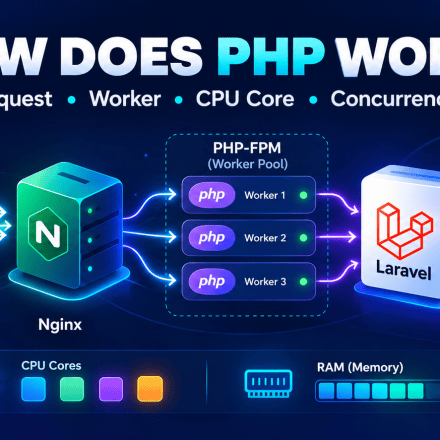
How PHP works with Nginx, PHP-FPM workers, Laravel, CPU cores, RAM, and database
October 6, 2026
How PHP Actually Works: PHP-FPM, Workers, CPU Cores, and Concurrency
Sherlock Holmes inspired illustration of evidence-based software debugging
September 30, 2026
Debugging Like Sherlock Holmes: Start With Evidence, Not Assumptions
YAGNI and over-engineering illustrated through the Room of Requirement
September 28, 2026
Your Software Is Not the Room of Requirement
AI-generated code and software engineering ownership illustration
September 28, 2026
AI Writes Faster. But Who Understands the Code?
Ship of Theseus illustration representing technical debt in software development
September 24, 2026
The Ship of Theseus and Technical Debt
Home/Software Engineering/AI Writes Faster. But Who Understands the Code?
AI-generated code and software engineering ownership illustration
Software Engineering

AI Writes Faster. But Who Understands the Code?

By Muhammad AR Zihad
September 28, 2026 3 Min Read
0

The old wizard is away.

The apprentice’s job is to fetch water. But he thinks, why do all this work manually?

He remembers a spell he heard from his master, brings a broom to life, and tells it to fetch water.

The broom starts working.

Bucket after bucket. Incredible speed.

There’s just one problem.

The apprentice doesn’t know the spell to make it stop.

The room begins to flood.

Desperate, he grabs an axe and splits the broom in two.

Now there are two brooms.

And both are fetching water.

In 2026, many of us have this spell in our hands.

Write a prompt, and the feature appears.
Tests pass. PR gets merged. Sprint ends.

But one question is becoming increasingly uncomfortable:

Who actually owns this code?

Nobody intentionally pushes unreviewed code to production. But the incentives almost always point toward delivery.

Velocity is measurable. Understanding is much harder to measure.

You can carefully review a 40-line PR. With an 800-line AI-generated PR, at some point the temptation to skim through it and say “LGTM” becomes very real.

And the problem is, the code may not even look bad.

Clean naming.
Well-written comments.
Confident-looking abstractions.

Mistakes don’t necessarily look ugly anymore.

The more subtle difference lies somewhere else:

“It works” and “I understand why it works” are not the same thing.

Under deadline pressure, we often treat them as if they are.

In my previous post about technical debt, I wrote about how decisions often survive while the context behind them disappears.

With unreviewed AI-generated code, the problem is even stranger.

The context hasn’t been lost.

It may never have existed in a human mind in the first place.

Then, when something breaks in production, debugging becomes archaeology.

The same business logic appears in three different places in three different forms because there were three different prompts.

Then we ask AI to fix the AI-generated bug.

It adds more code.

The axe falls.

Now there are two brooms.

In the Mahabharata, Abhimanyu knew how to enter the Chakravyuha, but he didn’t know how to get out.

AI can take us deep into an unfamiliar codebase incredibly quickly.

But when production goes down at 3 AM, we still need to know the way out.

There’s little reason to expect engineers to stop using AI to write code. Nor should we.

Instead, AI is shifting where engineering value lies.

Writing code is becoming cheaper.
Understanding code is becoming more valuable.

The valuable engineer will not simply be the one who can generate code.

It will be the engineer who understands which code to accept, which code to reject, when to stop abstracting, and where to start debugging when the system begins to fall apart.

Because AI won’t sit in the postmortem.

It won’t explain an architectural decision to the client.

And it won’t own the production incident.

That ownership still belongs to us.

So use AI as a pair programmer, not a ghostwriter.

In Goethe’s story, the master eventually returns and stops the broom.

The story reminds us of something important:

Knowing how to use power and knowing how to control power are not the same thing.

In our story, though, no master is coming back to fix everything for us.

We have to become the master ourselves.

So before you hit the merge button, try one simple test:

If this code breaks tomorrow, can I explain, without AI, why it was written this way?

If the answer is no, maybe the code isn’t really yours yet.

You’ve only awakened the broom.

Post Views: 30

Tags:

AI Assisted CodingAI-Generated CodeCode ReviewEngineering Ownership
Author

Muhammad AR Zihad

Follow Me
Other Articles
Ship of Theseus illustration representing technical debt in software development
Previous

The Ship of Theseus and Technical Debt

YAGNI and over-engineering illustrated through the Room of Requirement
Next

Your Software Is Not the Room of Requirement

No Comment! Be the first one.

    Leave a Reply Cancel reply

    Your email address will not be published. Required fields are marked *

    New ones

    • How PHP works with Nginx, PHP-FPM workers, Laravel, CPU cores, RAM, and database
      How PHP Actually Works: PHP-FPM, Workers, CPU Cores, and Concurrency
      by Muhammad AR Zihad
    • Sherlock Holmes inspired illustration of evidence-based software debugging
      Debugging Like Sherlock Holmes: Start With Evidence, Not Assumptions
      by Muhammad AR Zihad
    • YAGNI and over-engineering illustrated through the Room of Requirement
      Your Software Is Not the Room of Requirement
      by Muhammad AR Zihad
    • AI-generated code and software engineering ownership illustration
      AI Writes Faster. But Who Understands the Code?
      by Muhammad AR Zihad
    • Ship of Theseus illustration representing technical debt in software development
      The Ship of Theseus and Technical Debt
      by Muhammad AR Zihad

    Categories

    • Backend Engineering
    • PHP
    • Software Engineering

    You May Have Missed

    How PHP works with Nginx, PHP-FPM workers, Laravel, CPU cores, RAM, and database
    Backend Engineering PHP

    How PHP Actually Works: PHP-FPM, Workers, CPU Cores, and Concurrency

    Muhammad AR Zihad
    By Muhammad AR Zihad
    October 6, 2026
    Sherlock Holmes inspired illustration of evidence-based software debugging
    Software Engineering

    Debugging Like Sherlock Holmes: Start With Evidence, Not Assumptions

    Muhammad AR Zihad
    By Muhammad AR Zihad
    September 30, 2026
    YAGNI and over-engineering illustrated through the Room of Requirement
    Software Engineering

    Your Software Is Not the Room of Requirement

    Muhammad AR Zihad
    By Muhammad AR Zihad
    September 28, 2026
    AI-generated code and software engineering ownership illustration
    Software Engineering

    AI Writes Faster. But Who Understands the Code?

    Muhammad AR Zihad
    By Muhammad AR Zihad
    September 28, 2026
    Ship of Theseus illustration representing technical debt in software development
    Software Engineering

    The Ship of Theseus and Technical Debt

    Muhammad AR Zihad
    By Muhammad AR Zihad
    September 24, 2026

    Categories

    • PHP
    • Laravel
    • SQL
    • System Design
    • Privacy Policy

    Tags

    AI-Generated Code AI Assisted Coding Backend Development Code Review Concurrency CPU Debugging Engineering Ownership Laravel Maintainability Nginx Node.js Observability OPcache Over-Engineering Performance PHP-FPM Production Incidents Root Cause Analysis Software Architecture System design Technical debt YAGNI

    Copyright 2026 — Muhammad AR Zihad. All rights reserved.